
Quick answer
Work out what type of door it is (solid, hollow-core or plywood with a honeycomb panel) and repair according to the damage: a hole in a hollow door is covered with self-adhesive mesh and filler, a dent is filled with wood filler, and a swollen bottom is taken off, dried, planed and sealed along the bottom edge with primer or epoxy before painting.
What you need
- Screwdriver or drill driver, and a hammer with a thick nail to knock out the hinge pins
- Flexible filling knives, 3 and 8 cm
- Sanding block with 80, 120 and 240 grit paper
- Hand plane, orbital sander or electric planer
- Craft knife, pencil and ruler
- Trestles or two chairs with a blanket to rest the door on
- Self-adhesive fibreglass mesh for holes in board (Leroy Merlin, Bricodepot)
- Water-based wood filler and two-part epoxy filler (Ceys, Pattex, Loctite)
- White carpenter's glue (Titebond, Pattex)
- Wood sealing primer and water-based enamel (Bruguer, Titanlux, Montó)
- Sealer or bottom-edge epoxy for wood exposed to damp (Xylazel or two-part epoxy)
- Masking tape, plastic sheeting to protect the floor
Step by step
- 1
Identify the type of door
Knock on the panel with your knuckles. A hollow sound means a plywood door with a cardboard honeycomb core, very common in 1990s and 2000s flats in Valencia and Alicante. A dull sound means solid or chipboard core. An edge with a strip of wood and thin veneer means a veneered door.
- 2
Take the door off if you have to work on the bottom or corners
With the door slightly open and a wedge underneath, knock the hinge pins out from below with a thick nail, or unscrew the hinges. Get help: a plywood door weighs 12-18 kg. Rest it on two trestles with a blanket.
- 3
Small dents and sunken areas
Sand off loose paint and the edge of the dent with 80 grit. Fill with water-based wood filler in 3 mm layers, leaving 1 mm proud. Leave to dry for 1-2 hours, sand flush with 120 and 240 grit and prime before painting.
- 4
A hole in a hollow door
Trim the splintered edges of the hole with the craft knife to leave a clean outline. Stick a self-adhesive fibreglass mesh patch on the outside, a little bigger than the hole. Apply epoxy filler over the mesh in two layers of 2-3 mm, leaving it to dry between coats as the tin says. Sand flush.
- 5
Broken corners or edges
Remove splinters, glue back any pieces you can recover with white glue and hold them with tape. If material is missing, fill with epoxy filler, shaping it with a dampened knife and leaving it proud. Once cured, sand flush with the door using a sanding block.
- 6
Old knob or lock holes
If you have changed the handle and the old hole is bigger than the new one, glue in a round wooden plug (a 25-35 mm dowel), leave it for 2 hours, trim flush with the craft knife and sand. Then drill the new hole with a hole saw. There are separate guides on loose door handles.
- 7
Bottom swollen by damp
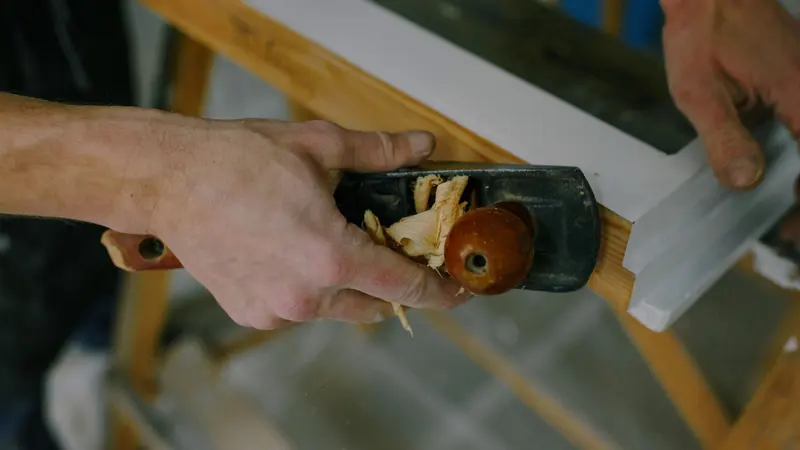
Measure the swelling by comparing the bottom with the top. Leave the door somewhere dry and ventilated for 3-5 days and check that it has stopped swelling. Mark the trim needed in pencil, which should not exceed 5-8 mm on thin plywood, and plane or sand the bottom edge along the grain.
- 8
Seal the bottom edge
The bottom edge is where water gets in when you mop. Apply two coats of sealing primer or epoxy to the bottom and to the lower 5-10 cm of both faces, and a third of enamel. A door sealed underneath lasts years longer without swelling.
- 9
Sand, prime and paint
Sand the whole panel with 120 grit to take the shine off, wipe off the dust and prime the repaired areas. Paint with two coats of water-based enamel in white or a colour (the detail is in how to paint a wooden door). Leave it to dry for 24 hours before closing the door.
- 10
Rehang and check the gaps
Hang the door and check that you have a 3-4 mm gap at the sides and top and 8-10 mm at the bottom above the finished floor. If it rubs, see door rubbing on the floor and adjust the hinges.
Repairing a plywood or wooden door: types of damage and the fix
A plywood door, the most common in Spanish homes built between 1980 and 2010, is a timber frame with two thin 3-4 mm panels and a cardboard honeycomb core. It is light, cheap and fragile: a knock from the handle of the door opposite, a child's kick or a suitcase can puncture the panel. Solid board or pine doors, by contrast, dent but do not puncture.
There are four common types of damage. Knocks and scratches are superficial and are fixed with filler. Holes go through the whole panel and need reinforcement behind. Broken corners and edges are rebuilt with epoxy. And swollen bottoms show that water has got in through the bottom edge, which is common in kitchens, bathrooms and coastal homes where floors are mopped with a lot of water.
| Damage | Material | Approximate time |
|---|---|---|
| Knock or scratch | Water-based wood filler | 30 min plus drying |
| Hole in a hollow door | Self-adhesive mesh and epoxy filler | 1 h plus drying |
| Broken corner or edge | White glue and epoxy | 45 min plus curing |
| Old knob hole | Wooden dowel and glue | 30 min plus 2 h drying |
| Swollen bottom | Planing, sealing and enamel | 1-2 h plus 3-5 days drying |
Common mistakes when repairing a door
- Painting without priming the filler. The shade shows and the paint absorbs differently, leaving marks.
- Trimming the bottom before it has dried. If you cut with the wood damp, a 10 mm gap is left once it dries.
- Forgetting the bottom edge. It is the spot most exposed to the mop; if you do not seal it, the swelling comes back.
- Filling a large hole with filler alone. Without mesh or reinforcement it sinks. Use a patch and epoxy.
- Planing the whole door when it only rubs in one corner. First check whether a hinge has worked loose: how to adjust door hinges.
- Thinking more filler means more strength. Non-structural filler will not hold hinge screws or lock screws.
When to call a professional
Call a carpenter if the door frame is damaged, if the hole covers more than a third of the panel, if the door is solid or hardwood with a finish you do not want to lose, if the swelling is more than 1 cm, or if several doors have the same problem (usually a leak or damp in common). It is also worth it if you have no help to take a door off: with the door on trestles we can plane it in 30 minutes.
With Manitas Costa, adjusting a door that rubs or will not close costs €40-70, replacing hinges (3) €50-90 and fitting a new interior door €90-150 labour, not including the door. For repairs to dents, filler and paintwork we apply our hourly rate: first hour €35-45, following hours €28-35. Fixed price before we start, payment when finished and a 6-month guarantee on labour.
See carpenter at your home, carpenter prices, and availability in Valencia or Alicante. If you want to repaint after repairing, see how to lacquer doors white.
Coastal damp and door bottoms
On the coast, door bottoms are the first thing to swell. The reason is simple: floors get mopped with water, unsealed plywood soaks it up through the bottom edge, and the humidity in the air does the rest. In poorly ventilated bathrooms, the door absorbs steam from showers all year round, and in beach homes the salt air speeds up the deterioration of hinges and screws.
If you live in a building where the comunidad de vecinos (residents' association) has rules on noisy works (almost all limit the hours), plan the sanding and cutting within those windows and work with a vacuum attached to limit dust. Working on the landing or the shared terrace without protection can cause annoyance and complaints.
Frequently asked questions
Can you repair a hole in a plywood door?
Yes. Trim the splintered edges, stick a self-adhesive fibreglass mesh patch on the outside, fill with epoxy filler in two layers, sand flush, prime and paint. For a very large hole, over 10-15 cm, it is worth fitting a wooden reinforcement behind it or replacing the door.
How do I fix the bottom of a door swollen by damp?
Take the door off, leave it to dry for 3-5 days somewhere ventilated and plane or sand the bottom until the gap is back. Then seal the bottom edge with sealing primer or epoxy and paint with enamel. If the swelling is more than 1 cm, the door is probably damaged inside and it is worth replacing.
What filler should I use to repair a wooden door?
For small dents, water-based wood filler in a matching shade; for corners and large holes, two-part epoxy filler. If the door is to be painted, the colour does not matter; if it is varnished, choose a slightly lighter shade and stain afterwards. They are sold at Leroy Merlin, Bricodepot or any ferretería (hardware shop).
How much does it cost to repair a wooden door?
Adjusting a door that rubs or will not close: €40-70. Replacing hinges: €50-90 for three. Fitting a new interior door: €90-150 labour. Repairs to dents and filler are charged by the hour: €35-45 for the first and €28-35 for following hours, at a fixed price.
Is it worth repairing or replacing a plywood door?
If the damage is a dent, a small hole or a corner, repair it: the materials cost a few euros. If there are several holes, the frame is damaged or the bottom is badly swollen, replacing the door is better value.