
Quick answer
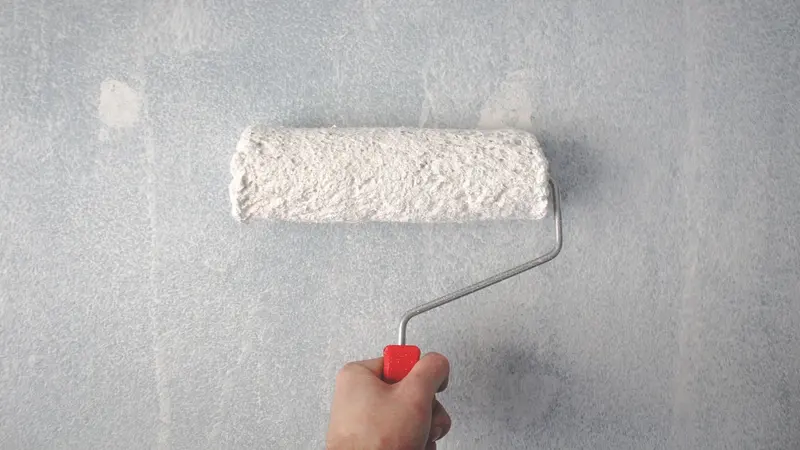
Protect the floor and frames, fill the holes and sand, wipe off the dust and apply a first coat of emulsion thinned by 10% if the wall is new or absorbent. Cut in the edges and corners with a brush and roll straight away with a medium-pile roller in overlapping vertical strokes, without stopping halfway across a section. Leave it for 4 hours, sand lightly and apply a second coat the same way.
What you need
- 22 cm medium-pile wool roller with a handle and extension pole
- 50 mm angled brush for cutting in
- Paint tray with a grid
- 10 cm filling knife and a sanding block
- Stepladder
- Masking tape (Tesa 4334 or similar)
- Dust sheets and cardboard for the floor
- Matt or washable satin emulsion, about 0.5 litres per m² for two coats (Bruguer, Montó or Titan)
- Water-based primer or sealer if the wall is new or absorbent
- Smoothing filler for dents and holes
- Sandpaper in 120 and 240 grit
- Soapy water and a cloth
Step by step
- 1
Empty and protect the room
Push the furniture into the middle of the room and cover it with plastic. Put cardboard or dust sheets on the floor. Unscrew the socket and switch covers or mask them with tape.
- 2
Check the wall with a torch
Shine the light across the wall at an angle and mark the holes, fine cracks and shiny or flaking areas with a pencil. Everything you mark has to be dealt with before painting.
- 3
Repair and sand
Fill holes and cracks with smoothing filler and a filling knife, leave it for 1 to 3 hours depending on the thickness and sand with 120 grit. If there are areas of loose paint, scrape with the knife back to a firm base.
- 4
Clean and let it dry
Vacuum or wipe with a dry cloth to remove the dust and clean greasy areas (kitchen, around switches) with soapy water. Wait 30 minutes until the wall is dry.
- 5
Mask frames and skirting boards with tape
Stick masking tape along the edges of door frames, skirting boards and ceilings, pressing it down firmly with a fingernail so no paint gets under. If the wall is very absorbent, apply a coat of sealer now and wait 2 hours.
- 6
Cut in the edges with a brush
Use the brush to paint a 5 cm strip in the corners, along the ceiling, the skirting board and around sockets. Work on a section of 1 or 2 m at a time so you can roll before it dries.
- 7
First coat with the roller
Load the roller, roll off the excess on the grid and paint a W shape about 60 cm wide, then fill in with vertical strokes, overlapping the painted area by 30%. Finish each section with a light stroke from top to bottom, without going back over an area that is starting to dry.
- 8
Let it dry and sand lightly
Wait 4 hours with the room ventilated. Go over it with 240 grit without pressing to remove grit and fluff, and wipe off the dust with a slightly damp cloth.
- 9
Second coat
Repeat the cutting in and the rolling in the same working direction. If you can still see through the paint, let it dry for another 4 hours and apply a third coat only on those areas.
- 10
Remove the tape and tidy up
Pull off the masking tape while the paint is still a little soft, at 45 degrees, without pulling straight out. Touch up with a small brush if needed and ventilate. The paint takes 24 hours to harden: do not hang pictures or push furniture against the wall for 48 hours.
Why roller marks show (diagnosis)
When a painted wall shows streaks, shinier patches or the outline of the roller, the paint is almost never the cause. It is the method. Marks appear for five reasons: painting an absorbent wall without priming it, letting the edge dry before you join up the next section, using a dirty or poor quality roller, applying too little paint and stretching it too far, and painting in the raking light from a window, which shows up every irregularity.
Before you start, look at the wall with a torch held at a low angle. You will see fine cracks, dents and shiny patches of old paint that you cannot see at a glance. Whatever shows up under the torch will show up again once the wall is painted, so fix it first.
If your flat dates from before 1980, remember that old paint on walls, doors and radiators can contain lead. Do not dry sand or scrape large areas of many-layered old paint. Sand wet, wear an FFP2 mask and gloves, keep children out of the room and clean up with damp cloths instead of sweeping.
- New wall or one repaired with plaster: primer, or a first coat thinned by 10% with water.
- Dark wall you want to cover with white: covering primer or three coats.
- Wall with damp or nicotine stains: stain-blocking primer first (Zinsser Cover Stain or similar).
- Wall already painted with emulsion in good condition: cleaning and a light sanding is enough.
Which paint and which roller to choose
For interior walls use a mid to high range matt or satin emulsion. Cheap paints have little pigment and need three coats to cover. Bruguer, Montó and Titan have washable ranges that you can find at Leroy Merlin and Bricodepot. A matt paint hides wall flaws better than a satin one, which in return is easier to wipe clean. In kitchens and bathrooms choose a washable or anti-mould paint.
The roller matters as much as the paint. For smooth walls, use a 22 cm medium-pile wool roller with a long handle and a good quality sleeve. For lightly textured walls, a long pile. A cheap roller sheds fluff and leaves a speckled finish. Wash it in water, squeeze it out and store it wrapped in cling film for the second coat.
| Surface | Roller | Paint |
|---|---|---|
| Smooth plaster or plasterboard wall | Medium-pile wool (12-14 mm) | Washable matt or satin emulsion |
| Lightly textured wall | Long pile (18-20 mm) | Matt emulsion |
| Ceiling | Medium pile, with an extension pole | White matt ceiling paint |
| Kitchen and bathroom | Medium pile | Washable or anti-mould emulsion |
Common mistakes when painting a wall
These slips explain most of the walls that end up being repainted:
- Starting without filling the holes. Filler takes 1 to 3 hours to dry and 5 minutes to sand. If you paint over an unfilled dent, the patch shows. See how to fill holes in a wall.
- Cutting in with a brush and waiting for it to dry before rolling. The brushed edge dries first and ends up darker. Cut in and roll straight away, section by section.
- Stopping halfway across a wall. If you leave a section half done, the join marks. Work from corner to corner or to a natural break.
- Not loading the roller enough. Stretching the paint leaves thin areas that show through. Load it properly, take off the excess on the grid and spread it with long strokes.
- Not removing the tape in time. It has to come off while the paint is still slightly wet, at 45 degrees, or it pulls paint away with it.
- Not sanding between coats. A light pass with 240 grit removes grit and roller fluff.
When to call a professional
Painting a wall is one of the most rewarding jobs to do yourself. It is worth calling us when the whole flat is empty or half emptied and you have no time, when there are high ceilings, popcorn texture (gotelé), old damp or cracks to deal with, or when you are about to let the flat and need it done well and fast.
With our painters service we price by the m²: walls in white €6-8/m², walls and ceilings €8-10/m², colour change €10-12/m². A 12 m² room comes to €180-300 and a complete 90 m² flat to €800-1,500. There are more examples in how much it costs to paint a flat. If you are in a city, see painters in Valencia or painters in Alicante. We give a fixed price by WhatsApp from photos and measurements, arrive in 20-45 minutes in the main cities and give a 6-month written guarantee.
Damp, heat and salt air: painting on the coast
On the Costa Blanca and in Valencia the humidity is high and walls near the sea absorb moisture. If you paint over a damp wall, the paint blisters within weeks. Check that the wall is dry by taping a piece of plastic sheet to it for 24 hours: if there are droplets underneath, there is damp and you need to deal with the cause first. We cover it in how to get rid of damp on a wall.
In summer the paint dries too fast with the windows open and direct sun. Lower the shutters on the windows the sun hits, paint first thing in the morning and avoid strong draughts, which leave join marks. In winter with high humidity, each coat can take up to twice as long to dry. On the seafront choose a washable paint, which copes better with condensation and with mould marks in corners and behind wardrobes.
Frequently asked questions
How many coats of paint does a wall need?
Two, as a minimum. On a wall already painted the same colour with good paint, one more coat and a touch-up can sometimes be enough. To go to white from a dark colour or to paint new plaster, allow for one coat of primer and two of finish. Add a third only on areas where it shows through.
How do I avoid roller marks when painting?
Use a good quality roller, load it well and do not stretch the paint. Work in sections without stopping in the middle and overlap your strokes before the edge dries. Paint in natural light rather than raking light, and not with direct sun on the wall. Sanding between coats also helps.
Do I need to prime a wall before painting it?
Yes if the wall is new, has fresh plaster or filler, is very absorbent or has stains. You do not need to if it was already painted with emulsion in good condition. An alternative is to thin the first coat by 10% with water. On walls with damp or nicotine stains, use a stain-blocking primer.
How long does wall paint take to dry?
It is touch dry in 1 or 2 hours and ready for the second coat after 4. It hardens fully in 24 hours and cures in about 7 days. With the high humidity of the coast in winter, or poor ventilation, allow double. Do not stick tape or hang pictures before 48 hours.
How much do you charge to paint a room?
Painting walls in white costs €6-8/m², walls and ceilings €8-10/m² and a colour change €10-12/m². A 12 m² room comes to €180-300. Fixed price by WhatsApp from photos and measurements, payment when we finish and an invoice including IVA (VAT).