
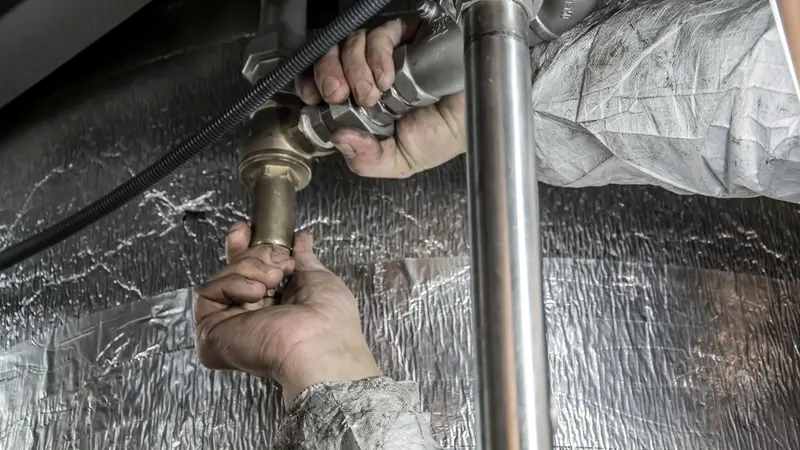
Quick answer
Close the isolating valves. If it drips from the spout with the tap closed, replace the cartridge (single-lever, 35 or 40 mm) or the valve head (two-handle, 1/2 inch ceramic quarter-turn). If it leaks at the base of the lever or the swivel spout, replace the O-rings and grease them with silicone grease. Clean the limescale off the seat before fitting the new part.
What you need
- Set of Allen keys (2, 2.5 and 3 mm)
- Adjustable spanner and a 17 mm spanner
- Small flat screwdriver
- Needle-nose pliers
- Cloth to protect the chrome
- Phone torch
- 35 or 40 mm ceramic cartridge (universal 8 to 15 euros at Leroy Merlin or Bricodepot, original Grohe, Tres or Roca 25 to 45 euros)
- 1/2 inch ceramic quarter-turn valve head, hot and cold pair (8 to 15 euros), or rubber washers for an old valve head
- Assorted O-ring set for the swivel spout (3 to 5 euros)
- Silicone grease for taps (4 to 8 euro tube)
- Cleaning vinegar for the limescale
Step by step
- 1
Turn off the water and plug the waste
Close both isolating valves under the sink or basin (or the mains if there are none). Open the tap to release the pressure. Put the plug in the waste so no screws fall down it.
- 2
Find and remove the lever screw
Single-lever: the screw is under the red and blue cap on the front or on the underside of the lever; remove it with the 2.5 or 3 mm Allen key and pull the lever upwards. Two-handle: lift the decorative cap on each handle with the flat screwdriver and loosen the Phillips screw. If you cannot see a screw, read how to take apart a single-lever tap with no visible screw.
- 3
Single-lever: unscrew the shroud and the retaining nut
Unscrew by hand the decorative ring (shroud) under the lever; if it is stuck, wrap it in the cloth and turn with the adjustable spanner. Underneath is the brass retaining nut: loosen it with the spanner and take it off. Photograph the cartridge before lifting it out so you remember the orientation.
- 4
Single-lever: replace the cartridge
Pull the cartridge upwards; if it is stuck, rock it gently with the pliers on the stem. Clean the inside of the body with vinegar and rinse. Fit the new cartridge of the same diameter, with its pins in the holes in the base and the same orientation. Screw the nut on by hand plus a quarter turn with the spanner.
- 5
Two-handle: replace the valve head or washer
With the handle off, unscrew the valve head with the 17 mm spanner (some have a threaded cover first). If it is a washer type, replace the rubber on the end and clean the seat in the body; if it is ceramic, replace the whole head with one of the same type and closing direction. Put a dab of silicone grease on the thread.
- 6
If it leaks at the base of the spout: replace the O-rings
On kitchen taps, unscrew the ring holding the swivel spout and pull the spout upwards. You will see two O-rings on the body: lift them off with the screwdriver, clean the limescale, grease the new ones with silicone grease and refit the spout.
- 7
Reassemble, turn the water on and check
Fit the shroud, the lever and the screw. Open the isolating valves slowly with the tap closed and wait a minute watching the base and the spout. Open the tap, close it and check there is no drip after 30 seconds.
Where the tap is dripping from: diagnosis in one minute
Drips from the spout with the tap closed. The classic case. On a single-lever mixer, the ceramic cartridge has discs scored by limescale or sand, or the bottom seal is deformed. On a two-handle tap, the rubber washer on the valve head is squashed, or the ceramic quarter-turn head has limescale between the discs. If closing it harder stops the drip for a while, it is definitely the valve head or the cartridge.
The tap leaks water from the base of the lever. Water comes out where the lever enters the body, only when you open it. It is the cartridge O-rings or the retaining nut holding the cartridge is loose. Tighten the nut a quarter turn; if it continues, replace the cartridge.
Leaks from the base of the swivel spout. Typical of a kitchen tap: a puddle appears around the base of the spout when you open it. It is the two spout O-rings, which crack with limescale. They are replaced without touching the cartridge.
Drips from the aerator for a few seconds after closing. Not a fault: it is the water left in the spout. If it is a high-spout tap and takes more than 10 seconds, the aerator is blocked and holding water; unscrew it and clean it with vinegar.
Damp patch under the sink or basin. Then the tap is not dripping: the flexible hose or the isolating valve is leaking. Replace them before the inner rubber bursts.
Which replacement to buy: cartridge or valve head
For a single-lever mixer you need the ceramic cartridge. They come in 25, 35 and 40 mm diameters; 35 is the most common in taps from Leroy Merlin, Bricodepot, Tres and Roca, and 40 in high-spout kitchen models. Measure the old cartridge once it is out, or take the whole tap to the ferretería (hardware shop). Brands with their own cartridge (Grohe 46048, Hansgrohe, Teka) sell the original at 25 to 45 euros; a universal cartridge costs 8 to 15 euros. There is more detail in how to replace the cartridge in a single-lever tap.
For a two-handle tap you need the valve head, which screws into the body under each handle. Old ones are multi-turn with a rubber washer (you can replace just the washer for 1 euro, but it is worth replacing the whole head for 5 to 8 euros). Modern ones are ceramic quarter-turn, 1/2 inch on basins and bidets, and 3/4 on some baths. Note the closing direction: the hot water head usually closes anticlockwise and the cold one clockwise, and they are sold in pairs.
Common mistakes when fixing a dripping tap
The first is not closing the isolating valves and trusting that the closed tap will hold. When you pull the cartridge out, water comes out under pressure through the tap body. If there are no isolating valves (many 1970s and 1980s kitchens), shut off the mains.
The second is fitting the new cartridge without cleaning the seat. The limescale and sand that destroyed the old one are still there. Wipe the inside of the body with a cotton bud dipped in vinegar and flush by opening the isolating valve for a moment with the body empty and a cloth over it.
The third is tightening the cartridge retaining nut with the spanner as if it were a car wheel. The nut goes on by hand plus a quarter turn: overtighten it and the cartridge seizes up and the lever is hard to move. And the fourth, forcing the handle on a two-handle tap to stop it dripping: every extra turn squashes the washer further and in the end you break the brass seat, which cannot be repaired.
- Put the plug in before you start: the 2.5 mm Allen screw drops straight down the waste.
- Photograph the orientation of the cartridge before taking it out (hot on the left).
- Use silicone grease for taps, never oil or petroleum jelly: they deform the rubbers.
When to call a professional
Call us if the lever screw is stripped or the Allen key slips, if the retaining nut will not come off because of limescale, if the tap leaks at the base and is built into the wall (shower), if there are no isolating valves and they need fitting, or if the tap is over 15 years old and the cartridge is no longer made. In that last case, replacing the tap usually works out cheaper than hunting for the part.
Our plumber service fixes a dripping tap for 40 to 70 euros, standard cartridge or valve head included in most cases, and does it in 30 to 45 minutes. If the tap has to be replaced, labour is 45 to 80 euros. We arrive in 20 to 45 minutes in Valencia, Alicante, Torrevieja and Benidorm. Fixed price by WhatsApp with a photo of the tap, 6 months written guarantee and an invoice with IVA (VAT). See all our rates in how much a plumber charges.
Limescale on the coast: why taps drip sooner here
The water in Alicante, Valencia and on the Costa Blanca is hard. The ceramic discs in the cartridge get scored by limescale crystals, rubber washers harden and aerators block. A cartridge that lasts 15 years in a soft water area lasts 5 to 8 here. A tap dripping one drop a second loses about 30 litres a day, nearly 1 cubic metre a month; on the hot side, you also pay for the gas or electricity to heat it.
Two habits that extend the life of a tap: unscrew and clean the aerator with vinegar every three months, and do not slam the lever shut; a ceramic valve cuts the water without pressure. If you have a holiday home, turn off the mains when you leave so a slow drip does not turn into a bill. If the tap is already too worn, see how to replace a kitchen tap or how to replace a basin tap.
Frequently asked questions
How much does it cost to fix a dripping tap?
If you do it yourself, a universal cartridge costs 8 to 15 euros and a valve head 5 to 8 euros. With our plumber, fixing a dripping tap costs 40 to 70 euros in Valencia, Alicante, Torrevieja and Benidorm, with the standard part included in most cases. If the tap has no spare available, replacing the tap costs 45 to 80 euros in labour.
Why does the tap only drip on the hot water?
Limescale builds up more on the hot side, because hot water makes it precipitate. On a two-handle tap, replace the left-hand valve head. On a single-lever mixer, the cartridge is scored on the hot disc and has to be replaced whole. If the drip only appears when the water heater is on, it may be excess pressure from expansion.
Can a dripping tap be fixed without replacing parts?
Sometimes. If the cartridge or the valve head has limescale between the discs, a 30-minute soak in vinegar and a clean reassembly can bring them back to life. It works on taps under 5 years old. On older taps or with scored discs, the drip returns within weeks, so it is worth fitting the new part.
How much water does a dripping tap waste?
One drop a second is about 30 litres a day, close to 1 cubic metre a month. A thin continuous trickle reaches 100 or 200 litres a day. At water rates in the Valencia region, that is between 3 and 15 euros a month, plus the energy if it is the hot side. A 10 euro cartridge pays for itself in two months.
What guarantee does the tap repair have?
All our plumbing repairs carry a 6-month written guarantee on labour, and the cartridge or valve head has the manufacturer's warranty. If it drips again within that period, we come back at no cost. You pay on completion in cash, by card, Bizum or bank transfer, with an invoice with IVA (VAT).